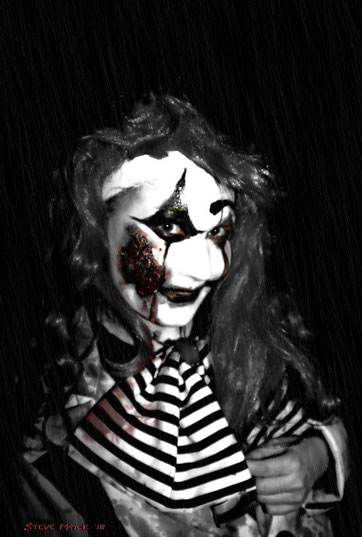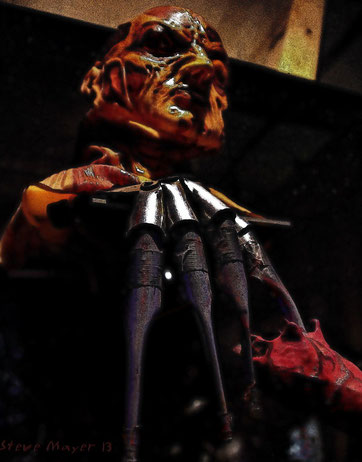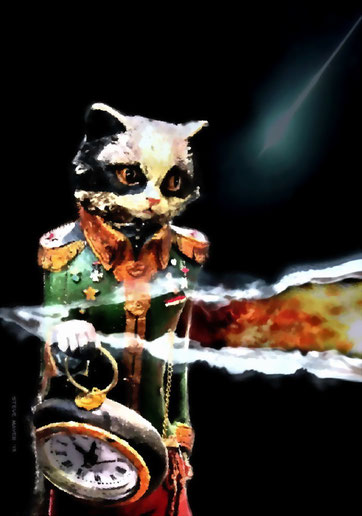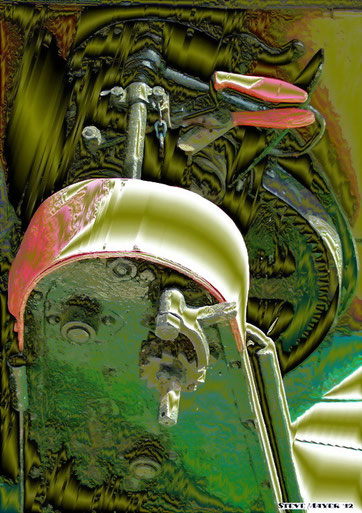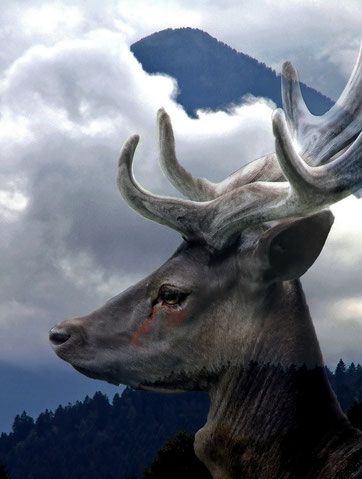


Steve Mayer ist der Künstlername im Bereich Illustration für Jörg Martin Munsonius
NEU
ENDE DES JAHRES 2025 FÜHRTE MICHAEL SCHMIDT VOM "VINCENT PREIS" - KOMITEE EIN INTERVIEW MIT DEM ILLUSTRATOR STEVE MAYER AKA JÖRG MARTIN MUNSONIUS - VERLEGER DER EDITION BÄRENKLAU UND CO-VERLEGER VON BÄRENKLAU EXKLSUIV. HIER DIE ENGLISCHSPRACHIGE FASSUNG FÜR UNSERE INTERNATIONALEN FREUNDE, AUTOREN UND RECHTEINHABER.
(END OF 2025 MICHAEL SCHMIDT FROM THE “VINCENT PRIZE” COMMITTEE CONDUCTED AN INTERVIEW WITH ILLUSTRATOR STEVE MAYER, AKA JÖRG MARTIN MUNSONIUS, PUBLISHER OF EDITION BÄRENKLAU AND CO-PUBLISHER OF BÄRENKLAU EXKLUSIV. HERE IS THE ENGLISH VERSION FOR OUR INTERNATIONAL FRIENDS, AUTHORS, AND RIGHTS HOLDERS.)
https://defms.blogspot.com/2025/12/jorg-munsonius-barenklau-interview.html
(English translation of the German version)
Michael Schmidt: Hello Jörg, what can I serve you for our interview: savory or sweet?
Jörg Munsonius: In a nutshell: I'll let myself be surprised.
Michael Schmidt: You're a jack of all trades and active in all areas, so it's hard to know where to start. Okay, you won the German Fantasy Award! Tell us about it!
Jörg Munsonius: That was in 2005 for the Lexikon der Fantasy-Literatur (Encyclopedia of Fantasy Literature), so it was quite a while ago, and I wasn't alone. The award was also given to Hans Joachim Alpers, Werner Fuchs, Ronald Hahn, and Hermann Urbanek. Most of them are probably even better known to fantasy readers than my name.
It was a rather heavy hardcover published by Fanpro, weighing over 1.6 kg, and was later supposed to be completed by Heyne as a paperback edition, similar to the SF Lexicon, but unfortunately that didn't work out. Everyone was happy, because it had been several years of work for those involved and it was a small satisfaction that it had been recognized in this way.
There had been nothing quite like it in the fantasy genre in Germany since the turn of the millennium. If you wanted to get an overview of the international scene, you had to pore over the standard works by John Clute, for example, or, for the European-language world, the truly opulent Corian publications, which always had me rushing to the public libraries to consult the latter loose-leaf collection.
Michael Schmidt: Who is Steve Mayer?
Jörg Munsonius: Steve is my artist name in the field of photography and illustration. Today, I mainly focus on image design. And that's because I like to see my name separated by “genre.” So, illustrations/photography as Steve Mayer, articles, essays, or my work as an editor under my real name Jörg Martin Munsonius, and as an author just Marten Munsonius. (No typo—Marten with an “e.”)
Michael Schmidt: How do you approach your illustrations? How do the images come about?
Jörg Munsonius: I prefer Affinity for creating my images digitally, a mixture of photos, collages, stock photos from image agencies or my own images, AI-prompted details, and the electronic brush to materialize my ideas in diverse visual worlds.
An example: The original template is an old black-and-white photo of the dancer, probably over 100 years old. Ultimately, this is what I made of it.
Michael Schmidt: Edition Bärenklau is...
Jörg Munsonius: A publisher of general fiction.
Michael Schmidt: How did the publishing house come about and what has changed over time?
Jörg Munsonius: Oops—that has nothing to do with the artist, ha. Okay—the predecessor publisher was “Bärenklau Verlag,” founded around the end of the 1990s. The aim was to promote a few young authors, and I really wanted to pursue my hobbyhorse at the time, “audiobooks.” Around the turn of the millennium or a year or two later, I met Uve Teschner, a great talent with his own mini studio, who realized my vision of burning CDs myself with perhaps a dozen audiobooks. Really – self-burned CDs, printed covers, and CD cases. So somewhere between amateur and semi-professional status.
I put a lot of heart and soul into it. And I'm still proud of my star “Thomas Ligotti,” whom Berlin author and artist Thomas Wagner and a author named Eddie Angerhuber had landed. A selection of Ligotti's short stories in German read by the two of them, and as the icing on the cake, the limited edition of 1-2-3 copies was personally numbered by the master himself over in America and all covers were autographed. Most of the copies were sold throughout Europe. I seem to remember that a university professor from Turkey ordered two copies.
The era then came to an end with the advent of Amazon eBooks for the German market around 2010/11. For me, the era of Bärenklau Verlag ended in the late 2000s, and I founded Edition Bärenklau. I focused on eBooks, and my contacts within the author scene quickly brought me a whole group of German-speaking authors and the reuse of their novels in what was then still a young medium.
Well, the big German publishing houses didn't see any competition in the early years. That's just how it is... Light fiction remained my motto – there's something for everyone. Thrillers, crime novels, science fiction, westerns, horror, and general fantasy. A few translations from the English-speaking world, mostly fantasy, rounded off the program.
At the end of the decade, printed copies were also supposed to make the program even more diverse. We experimented, but in the end, for internal reasons with licensees, it wasn't feasible in the way I had imagined.
I then founded a new publishing house with one of my former editors, Ms. Kerstin Peschel: Bärenklau Exklusiv. Our own shop followed.
And that brings us to the present day – and even though Edition Bärenklau has been scaled back and I am currently focusing more on Bärenklau Exklusiv, we still have a lot planned. The end is not yet in sight, even though the entire industry is currently in rough waters.
We are staying on course, no doubt about it!
Kerstin Peschel: Jörg Munsonius asked me to contribute to this article as co-publisher.
For me, texts are what melodies with accompanying lyrics are for a musician. Even when I read novels, the text creates its own “melody” in my mind, which has always been and continues to be disrupted by spelling or grammar mistakes, and sometimes even word errors. The bestsellers from major publishers are no exception. For this reason, I eventually made it my mission to bring books to market that had as few errors as possible and whose “text melody” sounded harmonious to me. This is how I began my career as an editor. Unfortunately, I quickly had to give up on the idea of an absolutely error-free book.
Since Edition Bärenklau was the only publisher at the time that responded to my comments about errors in their books, it stands to reason that I ended up working as an editor for this publisher.
Since the external appearance of books, i.e., the cover design, is also important to me, I started working with a graphic designer early on who designed covers according to my ideas.
All these efforts ultimately led to Jörg Munsonius approaching me one day and asking me if I could imagine founding a publishing house with him, where I would have the opportunity to realize everything I envisioned for a good book. I didn't think twice, and soon after, Bärenklau Exklusiv, our joint publishing house, was “born.”
Michael Schmidt: Which books are you particularly proud of?
Jörg Munsonius: That's a bit of an awkward question. Sorry, but we don't have any bad authors. They all have their strengths and - of course - a few weaknesses. The strengths clearly outweigh the weaknesses in all of them.
Nevertheless, I'll venture onto thin ice and justify this by saying that my taste cannot and should not be the taste of all readers, because otherwise we would all be reading the same thing. My co-publisher alone often—not always—favors different material, and ultimately we are both satisfied when the gigantic eBook market likes our “product” and the eBooks and even a few printed books are purchased.
What do I like? I'll let my co-publisher, Ms. Kerstin Peschel, go first: Kerstin Peschel: I quickly realized that my genre preferences complemented those of Jörg Munsonius. I love crime novels, historical novels, and when it comes to love and heartbreak, I'm not averse. I have a special passion for fairy tales that I can't explain.
During one of our many phone calls, Jörg Munsonius even said once: “What, you love crime novels AND historical novels? Then a western is just the thing for you.” I didn't want to believe him, but I let myself be persuaded to read a western and I had to agree with him: a western combines several genres. These “historical” novels usually also contain elements from the crime and adventure genres, sometimes even love and heartbreak. That's why I'm happy to give this genre another chance at our publishing house, this time as an eBook.
Personally, I'm very proud of our annual Christmas anthologies, which have been published for several years now and are very popular with readers as eBooks and in print, as are our fairy tale and story collections for the whole family and our crime-themed Advent calendars.
One of my latest passion projects is the re-release of the Tony Ballard novels by A. F. Morland under the new series title Tony Ballard Reloaded, which are available exclusively in the shops of Bärenklau Exklusiv, XEBAN-Verlag, and the Marvellous bookshop.
Jörg Munsonius: What's left for me? I should mention that I originally came from the hardcore fantasy genre. A few short stories and novels – non-fiction texts for Heyne SF Jahr, back when it was still under Wolfgang Jeschke, and for Dr. Franz Rottensteiner's Quarber Merkur, to name just two. Great people – sigh, unfortunately I don't have anything by Wolfgang Jeschke in my program, but I do have something by Franz Rottensteiner and Dr. Herbert W. Franke.
Thanks, guys.
And when you say Rottensteiner, as an old hand you can't ignore the Insel-Bücherei and later the Lila Reihe of the fantastic library of Suhrkamp Verlag.
The circle closes with Lovecraft, Smith, and other authors from the publishing house, edited by Franz Rottensteiner at the time – and from there it's not far to S.T. Joshi, who is an important helper for our publishing house Bärenklau Exklusiv.
A very nice selection is offered by “Unter dem Traumschleier” (Under the Dream Veil) by S. T. Joshi, or “A Mountain Walked” by S.T. Joshi, which we have published in several volumes.
I also appreciate the complete works of my American author Michael Minnis and love David Barker & W. H. Pugmire. But I am also proud of works from other genres in our publishing house: Thomas Ostwald, alias Tomos Forrest, a truly great author, especially when it comes to historical material.
Christian Dörge has compiled a truly superb Western anthology featuring stories by various authors for a partner publisher: “Die Winterlinie” (The Winter Line), hardcover, volume 50 of the Western-Colt series.
And in the crime fiction genre: Anja Gust & Kurt Geisler have launched a clever foray into the North German crime fiction landscape with “Fangfrische Küstenkrimis” (Freshly Caught Coastal Crime Stories). Definitely worth reading. And to mention Edition Bärenklau at least once more – “Jung, gierig, tödlich” (Young, Greedy, Deadly) by the author team Hans-Jürgen Raben and Lynda Lys is absolutely worth reading.
Michael Schmidt: Bärenklau offers a very wide range. Is that a blessing or a curse?
Jörg Munsonius: No, we are a small publishing house. But we want to reach many target groups. And we simply hope that some readers will be curious enough to look beyond the horizon and see what else an author does ...
Michael Schmidt: What can we expect in 2026?
Jörg Munsonius: I am delighted and proud that, together with our Italian partner Alberto Panicucci from the RiLL organization, we are able to present the third annual volume of award-winning fantasy stories by Italian authors in the genres of fantasy, science fiction, and weird fiction, published exclusively by Bärenklau.
I think all the winning stories are successful in their own way. It's a shame that modern Italian fantasy, after a brief era shortly before the turn of the millennium, is now virtually non-existent in German bookstores.
In the first days of January 2026, the short story collection "Die Häuser, die wir verloren haben" (The Houses We Lost) will be available in stores as an eBook.
A fantastic anthology of new Polish fantasy fiction will be released in the spring. Krzysztof Dąbrowski will present it in Polish and in German translation. In both languages, it will probably be called “Legacy of Shadows – An Anthology of Polish Horror” at least in the subtitle, but I haven't decided yet.
Of course, a new anthology, “Fangfrische Küstenkrimis” (Freshly Caught Coastal Crime Stories), edited by Nick Jentsch, will also be published under the provisional title: “Seemannsgarn von Landratten und Leichtmatrosen – Maritime Kurzkrimis mit salziger Brise” (Sailors' yarns from landlubbers and deckhands – Maritime short crime stories with a salty breeze).
So, enough. All the others are good too, and I'd probably have to add another 50 pages...
Michael Schmidt: You write yourself. What exactly do you write, and what distinguishes your prose?
Jörg Munsonius: I think my own work is very narrow, mainly fantasy, horror, and science fiction. Almost everything has been written in collaboration with fellow authors. I tend to write series sequels – David Murphy (Gegen die Dämonender Dämmerung). Arik, Der Schwertkämpfer (Arik, the swordsman). Corrigan - Die Endzeit-Saga (Corrigan, the end-time saga). All originally published separately by different publishers. Hardcovers, paperbacks, and a few booklets.
Third parties should act as readers and critics.
My publisher shadow is simply much bigger and takes up all my time. Steve Mayer takes care of the rest. And he really enjoys doing it.
Michael Schmidt: You've been in the business for a long time. How would you characterize the change in fantasy literature during this time?
Jörg Munsonius: Everything has its time.
The change? At the moment, you get the feeling that publishers are focusing on a few titles and their sequels, if they've already been successful, and then prolonging that as long as possible. That's just the way things are. Anything new or unusual is avoided as much as possible. And when something interesting comes along, such as young adult or gay romance, to name just two genres, then everyone tries to jump on the bandwagon. Unfortunately, even we as a small publisher are no exception.
Michael Schmidt: What strengths do you see in German-language fantasy and Weird Fiction?
Jörg Munsonius: German-language fantasy? I love good fantasy and Weird Fiction from every country...
Michael Schmidt: A word to the crowd out there!
Jörg Munsonius: It would be wonderful if there were an interested and, above all, “big crowd out there!” At least I'm not giving up hope for genres beyond the mainstream.
End

Edward Martin, Schottland mit Steve Mayer: WAITING, 2016